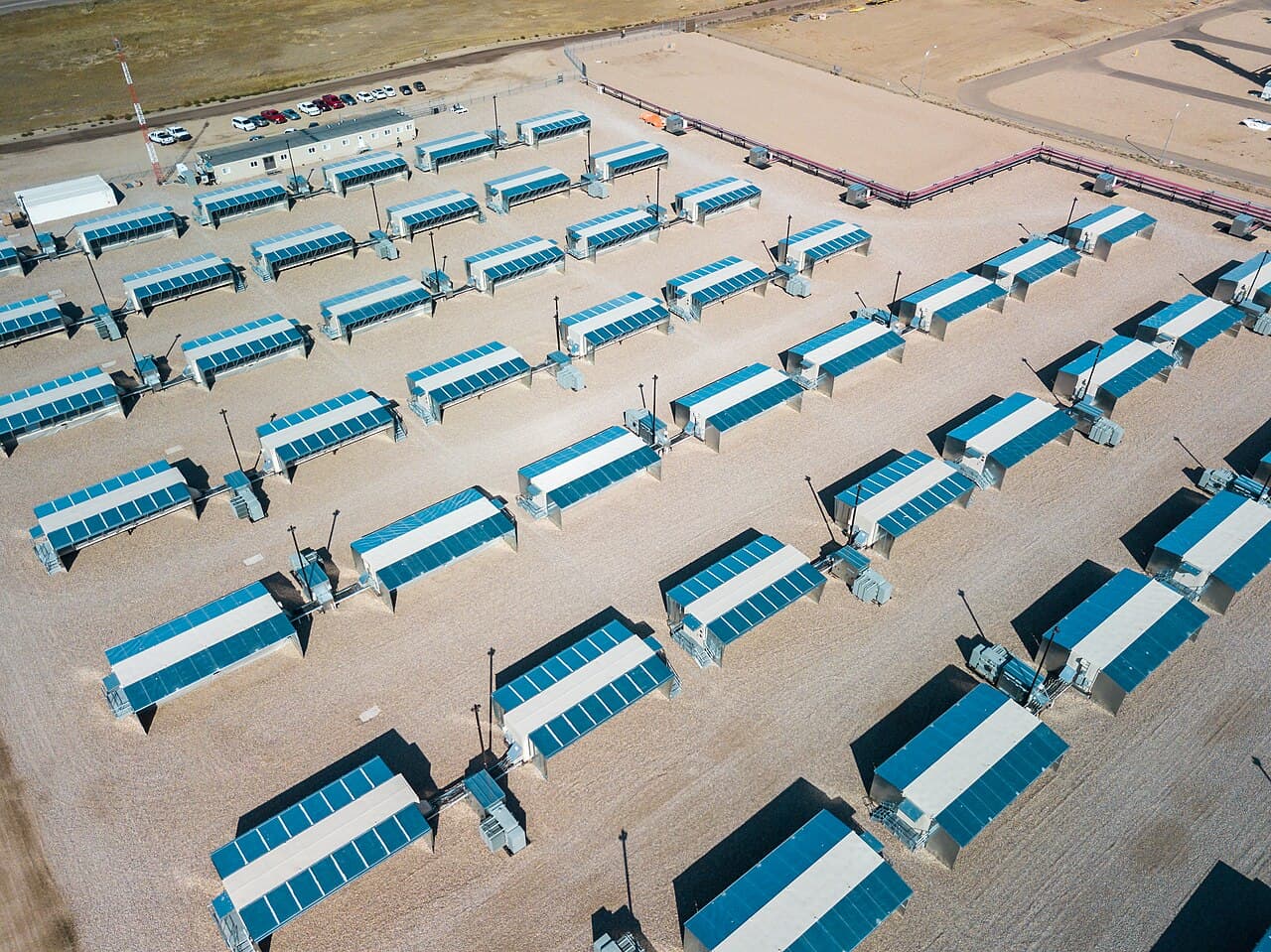
Build a mining farm in this order: secure the power, choose the site and cooling method to suit the climate, design the electrical path from the utility to each miner, then add network, racking or containers, and only then schedule the miners to arrive as the site is energised. Power decides the size, the cost and the timeline of everything else. Projects that start by ordering machines usually end up storing them.
Key points
- Sign nothing for hardware until you know your capacity in kW, the all-in price per kWh, the contract term and the date power will be live.
- Pick cooling for your hottest day and your water situation, then pick miners of that cooling type.
- Match the distribution voltage to the miners' published input range before buying transformers.
- Long-lead items are the utility connection, transformers and switchgear. Miners are the easiest part to obtain and the costliest to leave idle.
- Commission in stages under load, with measurements, before filling the site.
1. Power first
Capacity. Establish how many kW you can draw continuously, at what voltage, and where the meter sits. Utility and transformer ratings are in kVA, and real power is kVA × power factor. If the meter is on the high-voltage side, transformer losses are yours. How Many Miners Fit in 1 MW? turns capacity into a machine count.
Price. Use the all-in price. Industrial tariffs often combine an energy charge per kWh with a demand charge per kW of peak draw per month. Miners run near full load all the time, so the demand charge spreads over roughly 730 hours a month (8,760 ÷ 12).
Effective price per kWh = energy charge + (demand charge per kW-month ÷ 730)
An illustrative demand charge of $10 per kW-month adds 10 ÷ 730 = $0.0137 per kWh. Add transmission fees, taxes and any fuel adjustments, then test that price in the calculator against the efficiency of the machines you are considering. If the margin is thin on today's network values, the site does not work, however well it is built.
Contract. Read for term and renewal, minimum take, deposits, interruption or curtailment clauses, who owns and maintains the transformer, and the utility's own timeline for the connection. A curtailable supply can be cheap and still suit mining, provided you can shut down and restart in an orderly way.
2. Site and cooling
All the power your miners draw becomes heat. 1 kW is about 3,412 BTU/h, so 1 MW of miners rejects about 3.4 million BTU/h continuously.
| Air | Hydro | Immersion | |
|---|---|---|---|
| Heat removed by | Outside air through the miners | Coolant loop to dry coolers | Dielectric fluid to a heat exchanger |
| Sensitive to | High ambient temperature, dust, humidity | Ambient temperature at the dry cooler, coolant quality | Fluid cost and handling |
| Noise at the boundary | Highest | Lower, from dry cooler fans | Lower, from dry cooler fans |
| Mechanical complexity | Lowest | Pumps, piping, coolant chemistry | Tanks, pumps, fluid management |
| Power per unit | Lower | Higher | Varies with model and mode |
Two sizing formulas show the scale. They are physics, not a design:
- Air:
flow (m³/s) = heat (kW) ÷ (1.2 × 1.005 × temperature rise in K), using sea-level air density of 1.2 kg/m³. For 1,000 kW and a 15 K rise, 1,000 ÷ 18.09 = 55.3 m³/s, about 199,000 m³/h. - Water:
flow (L/min) = heat (kW) × 60 ÷ (4.186 × temperature rise in K). For 1,000 kW and a 10 K rise, 60,000 ÷ 41.86 = 1,433 L/min. Glycol mixtures carry less heat per litre and need more flow.
Check the miner's published limits against your climate. Bitmain's published operating range for the air-cooled Antminer S21 is 0 to 45°C, and its documentation reduces the maximum temperature at altitude. Thin air at elevation also carries less heat per cubic metre.
For the site itself, confirm zoning and permits with the local authority, noise limits at the property line, truck and crane access, flood risk, dust sources, physical security and a wired internet route. See ASIC Cooling Methods Compared.
3. Electrical one-line
A one-line diagram shows the path of power as a single line with each device on it. Yours will look broadly like this:
| Stage | Equipment | Decide |
|---|---|---|
| Utility interface | Metering, isolation, protection relay | Supply voltage, fault level, metering point |
| Medium voltage | Switchgear | Protection settings, number of feeders |
| Transformation | Transformers | kVA, secondary voltage, losses, redundancy |
| Low-voltage main | Main switchboard and breakers | Busbar rating, short-circuit rating |
| Distribution | Feeder breakers, cables, sub-boards | Cable sizes, voltage drop, phase balance |
| Final circuits | PDUs | Breaker per outlet group, outlet type, metering |
| Load | Miners | Input range, connector, current per unit |
Currents at this scale are large. From P = √3 × V × I × PF, a 1,000 kW load at 415 V with an illustrative power factor of 0.95 draws 1,000,000 ÷ (1.732 × 415 × 0.95) = 1,464 A. That is why sites split load across several transformers and feeders.
Secondary voltage must suit the miners. Bitmain publishes a 220 to 277 V single-phase input for the air-cooled Antminer S21 and 380 to 415 V three-phase for the Antminer S21 XP Hyd. On a 415 V system, single-phase machines connect phase to neutral at 415 ÷ √3 = 240 V and must be spread evenly across the three phases.
All of this must be designed by a qualified electrical engineer and installed by licensed electricians to local code, including earthing, surge protection and protection coordination. Under North American practice (NEC), continuous loads are commonly limited to 80% of breaker rating. Other regions follow their own codes.
4. Network
Miners use little bandwidth and need a stable connection. A miner that cannot reach its pool earns nothing.
- One wired Ethernet port per miner, plus spare ports. See networking.
- A separate management network with no inbound access from the internet.
- Two independent uplinks if the location allows.
- A small UPS for switches and routers so brief power dips do not disconnect the fleet.
- Address reservations and a naming scheme that maps each miner to its rack position.
5. Racks or containers
In a building, arrange racks so every miner draws from a cold side and exhausts to a sealed hot side. Recirculated exhaust is a common cause of overheating in air-cooled rooms. Check floor loading and leave room to pull any unit without stopping its neighbours.
Containers arrive with racking, distribution and cooling already integrated, which shortens site work and allows relocation. See the ASIC Mining Container Guide.
6. Procurement and lead times
Ask every supplier for lead time in writing and build the schedule backwards from energisation. The utility connection, transformers and switchgear usually govern. Order miners so they arrive as circuits are ready. A machine in a box earns nothing, and manufacturer warranties count from shipment: Bitmain, for example, publishes 365 days from the shipping date for the Antminer S21.
7. Commissioning
- Complete inspections required by the utility and the local authority.
- Have the electrician test insulation, earthing and protection before energising.
- Energise transformers and switchboards unloaded and check voltages.
- Run cooling alone. Pressure-test and leak-test liquid loops before connecting miners.
- Add miners in blocks. At each step measure phase currents, voltage at the far end, and inlet and outlet temperatures.
- Scan terminations with a thermal camera under load and re-check any hot joint with power isolated.
- Record baseline hashrate, power and temperatures per row.
8. Operations
Plan for monitoring and alerting, a stock of spare fans, power supplies and hashboards, a cleaning schedule, a written procedure for curtailment and restart, staff cover, security and insurance. ASIC Miner Maintenance covers the routine.
Main cost categories
| Category | Includes | Scales with |
|---|---|---|
| Power connection | Utility fees, studies, line extension, deposits | MW and distance to the grid |
| Transformers and switchgear | MV gear, transformers, protection | kVA |
| Low-voltage distribution | Switchboards, cable, PDUs | kW and circuit count |
| Cooling | Fans and filters, or pumps, piping, dry coolers, tanks and fluid | kW of heat and climate |
| Structure | Building works, slab, racks or containers | Unit count |
| Mining hardware | Miners, power supplies, cords | Hashrate and price per TH |
| Network and monitoring | Switches, cabling, sensors, software | Unit count |
| Freight, duty and tax | Shipping, insurance, import charges | Origin, destination, value |
| Installation | Electrical labour, crane, testing, permits | Site complexity |
| Spares and working capital | Spare parts, deposits, first power bills | Fleet size |
| Operating costs | Electricity, staff, maintenance, insurance, pool fees | Running hours |
Common mistakes
- Buying miners before power is contracted.
- Sizing to nameplate power with no allowance for tolerance, cooling overhead or losses.
- Choosing a secondary voltage the miners are not rated for.
- Designing cooling for average weather instead of the hottest week.
- Letting hot exhaust recirculate to the intake.
- Unbalanced phases, which overload one conductor while the others have room.
- No spares on site, so one failed fan idles a machine for weeks.
- Ignoring noise limits until neighbours complain.