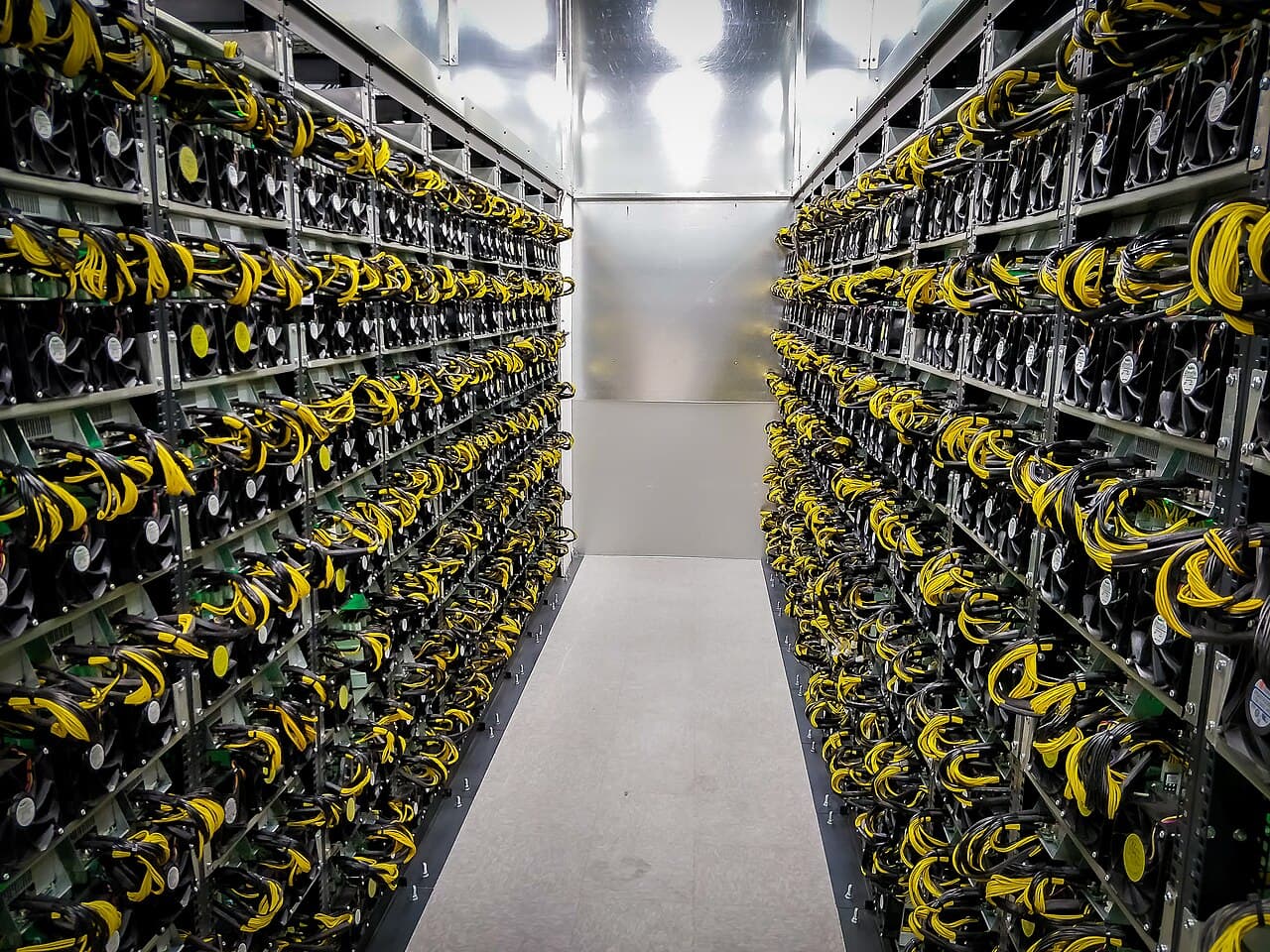
There are four practical ways to cool ASIC miners: plain air, air pre-cooled by evaporation, hydro (cold plates in a water loop) and immersion (machines submerged in dielectric fluid). All four end the same way, by rejecting heat to outdoor air. They differ in how many steps the heat takes to get there, what temperature limits each step, and whether you spend your money on buildings and fans or on pumps, pipework and fluid. This guide compares them on fixed criteria and points you to the detailed guide for each.
Key points
- Choose the cooling method from site conditions first: peak ambient temperature, humidity, dust, water availability, noise limits and space.
- Air has the lowest entry cost and the highest exposure to the environment. Liquid methods move cost into plant and remove the machine from the airstream.
- Evaporative cooling only works where the air is dry, and it adds humidity that manufacturers warn about.
- Liquid-cooled machines accept coolant far warmer than the air an air-cooled machine accepts, which is why dry coolers work in hot climates.
- Compare methods on total power, miners plus cooling, not on machine efficiency alone.
One framework for all four
Every method is a chain from chip to atmosphere. Each link needs a temperature difference to move heat, so the chain has a budget: the chip's limit at one end and the outdoor air at the other.
| Method | Heat rejection path |
|---|---|
| Air | Chip → heatsink → air through the machine → exhaust to outdoors |
| Evaporative-assisted air | Outdoor air → wet pad (cooled by evaporation) → machine → exhaust to outdoors |
| Hydro | Chip → cold plate → water-based coolant → plate heat exchanger → dry cooler or cooling tower |
| Immersion | Chip → dielectric fluid → plate heat exchanger → water loop → dry cooler or cooling tower |
Two outdoor temperatures matter. Dry-bulb temperature is what a normal thermometer reads; air cooling and dry coolers cannot cool below it. Wet-bulb temperature is the lowest temperature evaporation can reach, and it is well below dry-bulb only when the air is dry. Evaporative pads and cooling towers work towards wet-bulb.
The machine side of the budget is published by the manufacturer. Bitmain publishes an operating temperature of −20 to 45 °C for the air-cooled Antminer S21 XP, and MicroBT publishes −5 to 35 °C for the WhatsMiner M60S. For liquid-cooled models the limit is on the coolant: Bitmain publishes 20–50 °C inlet for both the S21 XP Hyd. and the S21 XP Imm. Coolant at 45–50 °C can still shed heat to 40 °C air through a dry cooler; intake air at 45 °C leaves an air-cooled machine with no margin.
The criteria
- Capex shape: where the capital goes, apart from the miners.
- Opex: cooling energy, consumables and labour.
- Density: how much power fits in one machine and one container or room.
- Noise: sound at the machines and at the site boundary.
- Climate suitability: which climates it handles without derating.
- Water use: whether it consumes water in normal operation.
- Maintenance skill: what your staff need to be able to do.
Comparison table
| Criterion | Air | Evaporative-assisted air | Hydro | Immersion |
|---|---|---|---|---|
| Capex shape | Building or container shell, racks, filters, exhaust fans | As air, plus pad walls, water supply, pumps and water treatment | Pumps, pipework, manifolds, heat exchanger, dry cooler or tower, coolant | Tanks, dielectric fluid, pumps, heat exchanger, dry cooler or tower |
| Opex | Site fan power, filter changes, frequent dust cleaning, fan replacement | As air, plus water, pad replacement and scale control | Pump and cooler fan power, coolant testing and replacement, filters | Pump and cooler fan power, fluid top-up and testing |
| Density | Lowest. Limited by air volume per machine | Same machines as air | High. More power per chassis, compact racks | High. Machines packed closely in tanks |
| Noise | High at the machine and at exhaust | High | Low at the machine; cooler fans outdoors | Low at the tank; cooler fans outdoors |
| Climate suitability | Cool to moderate, clean air | Hot and dry; poor in humid climates | Hot, dusty or cold with antifreeze | Hot, dusty, humid or coastal |
| Water use | None | Continuous | None with a dry cooler; continuous with a tower | None with a dry cooler; continuous with a tower |
| Maintenance skill | Basic electronics handling and cleaning | As air, plus water system upkeep | Plumbing, water chemistry, leak testing | Fluid handling, pumps, spill control |
| Environment reaches the boards | Yes | Yes, with added moisture | No | No |
| Machine type | Air-cooled models | Air-cooled models | Hydro models only | Immersion models, or converted air units |
Notes on each method
Air
The machine is self-contained: plug it in and it cools itself, provided you supply enough cool air and remove the exhaust. The work is in the building. Hot exhaust must not find its way back to the intake, and intake air must be filtered without choking flow. Dust is the main enemy; Bitmain recommends cleaning about once a month and running in a low-dust environment. Details and published figures are in Air vs Hydro Bitcoin Miners.
Evaporative-assisted air
A wet pad wall (also called a water curtain) at the intake cools incoming air by evaporating water into it. In a hot, dry climate this can bring intake air down substantially; in a humid climate it does almost nothing, because the air cannot take up more water. The machines are ordinary air-cooled units.
The cost is humidity and water. Bitmain's guidance for Antminers recommends keeping humidity below 65% and says not to use a water curtain where a lot of dust has accumulated, because moisture adheres to the dust and corrodes hashboards. Its specifications allow 10–90% relative humidity only without condensation. So evaporative cooling needs clean machines, good filtration ahead of the pads, and control that backs off when humidity is high. Hard water also scales the pads and needs treatment or bleed-off.
Hydro
Cold plates and a closed coolant loop take the heat straight from the chips to an outdoor cooler. You get quiet, sealed machines with high power per unit, and you take on a plant that must hold flow, temperature, pressure and coolant chemistry within manufacturer limits. Components, sizing and failure modes are in Hydro Mining Explained.
Immersion
Machines sit in tanks of dielectric fluid that is pumped through a heat exchanger. Nothing in the environment reaches the boards and there are no machine fans. You pay for tanks and fluid, and servicing is slower and messier. Dielectric fluids carry less heat per litre than water, so flows are larger than in hydro. See Immersion Mining Explained.
Counting cooling power
A miner's rated wall power includes its own fans but not your site's cooling. To compare methods, measure or estimate total site power and divide by miner power. That ratio is commonly called PUE (power usage effectiveness).
Effective efficiency = miner J/TH × PUE.
An illustrative example: a site with 1,000 kW of miners rated at 15 J/TH and 50 kW of cooling and auxiliary load has a PUE of 1,050 ÷ 1,000 = 1.05 and an effective efficiency of 15 × 1.05 = 15.75 J/TH. Ask any cooling supplier for the design PUE at your peak ambient temperature and check what it includes. Then put the effective figure, not the datasheet figure, into the electricity cost calculator.
Shortlisting by site condition
| Site condition | Methods to shortlist | Reason |
|---|---|---|
| A few machines, existing room | Air | No plant to build |
| Cool, clean air most of the year | Air | Free cooling with little filtration |
| Hot and dry, water available | Evaporative-assisted air, hydro, immersion | Evaporation works; liquid methods also suit |
| Hot and humid | Hydro, immersion | Evaporation is ineffective and humid air harms boards |
| Dusty, sandy or coastal | Hydro, immersion | Boards are out of the airstream |
| Noise limits at the boundary | Hydro, immersion | No machine fans |
| No water supply | Air, or hydro or immersion with dry coolers | No evaporative loss |
| Heat reuse planned | Hydro, immersion | Heat arrives as warm liquid |
| Severe winters | Air, or hydro with antifreeze | Air units must be kept above their minimum start temperature; liquid loops need freeze protection and inlet temperature control |
Whichever method you choose, power distribution must be designed and installed by a qualified electrician to local code, and the cooling plant's own load belongs in that design.
Sources
- Bitmain Support, "Do's and Don'ts of a New ANTMINER", https://support.bitmain.com/hc/en-us/articles/360001836994-Do-s-and-Don-ts-of-a-New-ANTMINER, checked 2026-10-01.
- Bitmain Support, "Environmental Requirements for ANTMINERs", https://support.bitmain.com/hc/en-us/articles/360021472873-Environmental-Requirements-for-ANTMINERs, checked 2026-10-01.
- Bitmain Support, "How to clean and dust the ANTMINER?", https://support.bitmain.com/hc/en-us/articles/115004520173-How-to-clean-and-dust-the-ANTMINER, checked 2026-10-01.
- Bitmain Support, "S21 XP Hyd Specification", https://support.bitmain.com/hc/en-us/articles/34523540504857-S21-XP-Hyd-Specification, checked 2026-10-01.