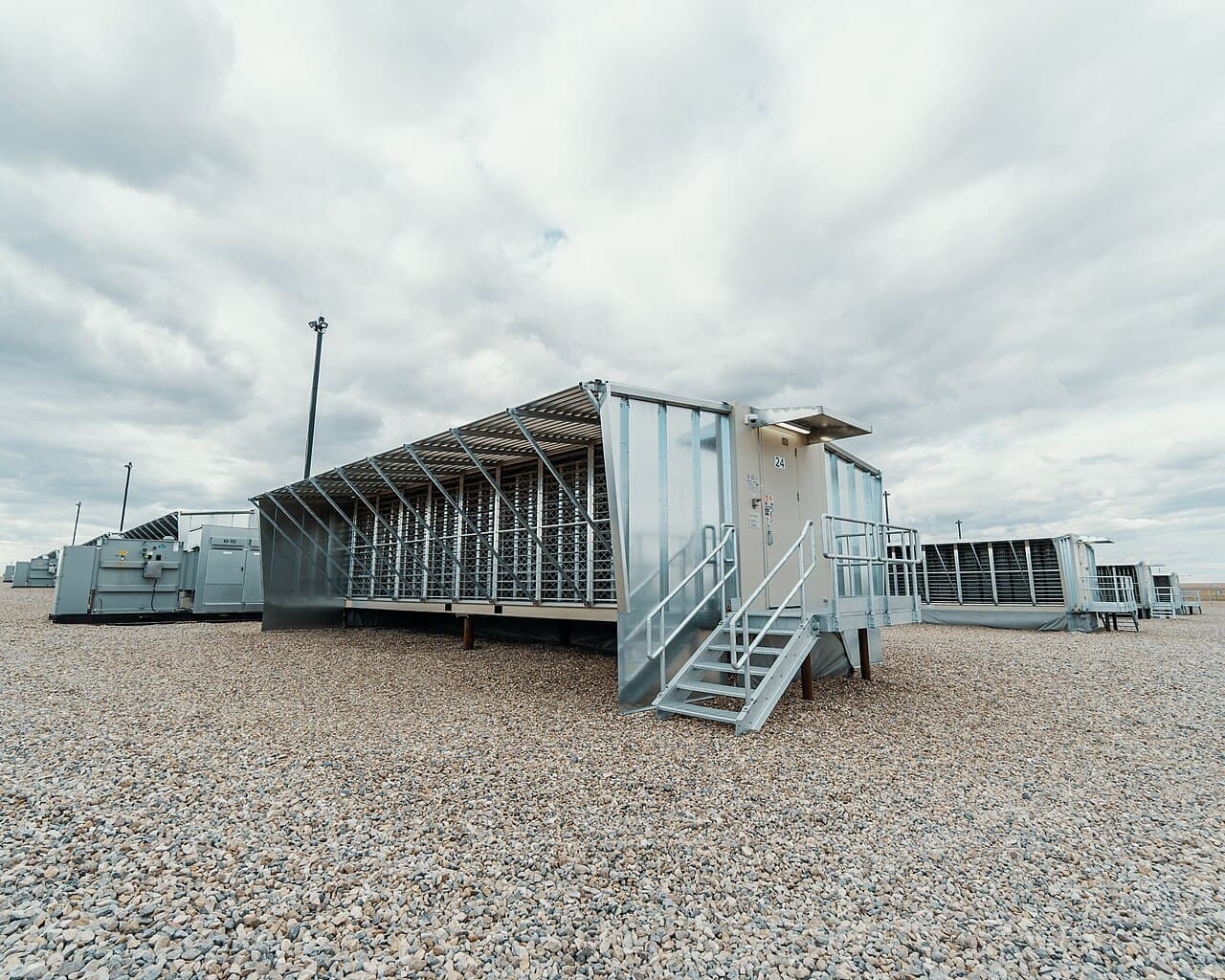
A mining container is a shipping-container-sized enclosure delivered with racking, power distribution and cooling already built in, so that site work is reduced to a foundation, a power feed and a network link. There are three kinds (air, hydro and immersion), and they are not interchangeable. Choose the miner model first, then specify the container around that model's published power, voltage and cooling requirements.
Key points
- A container is built for one cooling method and often for specific miner models. Confirm compatibility with your exact model and version in writing.
- Slot count alone tells you nothing. Check rated power, input voltage and cooling capacity at your design ambient temperature.
- For hydro and immersion, the dry cooler decides how cool the liquid can get. It cannot cool below outdoor air temperature.
- Establish what is not included. Transformers, dry coolers, coolant, miners and foundations are frequently outside the container price.
- Electrical connection must be designed and carried out by qualified electricians to local code.
The three types
| Air container | Hydro container | Immersion container | |
|---|---|---|---|
| Miner type | Air-cooled, with fans | Hydro models with cold plates | Immersion models, or air models adapted for fluid |
| Heat path | Outside air through miners to exhaust | Coolant through miners to a dry cooler | Dielectric fluid around boards to a heat exchanger, then a dry cooler |
| Inside | Racks, intake filters or louvres, exhaust fans, PDUs, switches | Racks, supply and return manifolds, quick couplings, pumps, PDUs, controls | Tanks, fluid, pumps, heat exchangers, PDUs, lifting gear, controls |
| Outside | Clear space for intake and exhaust | Dry cooler or cooling tower, pipework | Dry cooler or cooling tower, pipework |
| Sensitive to | Dust, humidity, high ambient temperature | Coolant quality, leaks, ambient at the dry cooler | Fluid cost, fluid handling, ambient at the dry cooler |
| Noise | Highest, from miner and exhaust fans | Lower, mainly dry cooler fans | Lower, mainly dry cooler fans |
| Routine work | Filter changes, cleaning | Coolant checks, strainer cleaning, leak checks | Fluid top-up and filtration, messier servicing |
Air
Miners sit on shelves between a filtered intake wall and an exhaust wall. Exhaust fans hold the hot side at lower pressure so that air passes through the machines once and leaves. Some designs add evaporative pads at the intake, which need a water supply and raise humidity. Browse air-cooled solutions.
Hydro
Each miner connects to supply and return manifolds. Pumps circulate coolant through the miners and out to a dry cooler, sometimes through a plate heat exchanger that separates a clean inner loop from the outdoor loop. Expect an expansion vessel, strainers, flow, pressure and temperature sensors, and leak detection. See Hydro Mining Explained.
Immersion
Miners are submerged in tanks of dielectric (electrically non-conducting) fluid. Pumps move the fluid through a heat exchanger, and a water or glycol loop carries the heat to a dry cooler. See Immersion Mining Explained.
What to specify
Miner compatibility
State the manufacturer, model and hashrate version. The supplier should confirm slot dimensions, power connector, coolant connector and whether the control software recognises the model. Per-slot power differs widely between models. Bitmain publishes 5,676 W for the Antminer S21 XP Hyd. and 11,020 W for its larger U3S23H hydro unit. The same number of slots means a very different electrical and thermal load.
Power capacity
Container load = slots × per-unit power at upper tolerance + pumps, fans and controls
For 200 units of a hydro miner published at 5,676 W, miner load is 200 × 5.676 = 1,135.2 kW. Bitmain states a ±5% power tolerance for that model, so allow 1,135.2 × 1.05 = 1,192 kW, plus the container's own auxiliaries. Ask for the rated continuous load, the main breaker rating and the auxiliary power draw. For the site-level calculation see How Many Miners Fit in 1 MW?.
Voltage
The container's input and internal distribution voltage must fall inside the miner's published input range.
| Miner (manufacturer-published) | Input range |
|---|---|
| Bitmain Antminer S21 XP Hyd. | 380 to 415 V three-phase |
| MicroBT WhatsMiner M63S | 380 to 480 V |
| Bitdeer SEALMINER A4 Pro Hydro | 380 to 480 V three-phase |
| Bitmain Antminer S21 (air) | 220 to 277 V single-phase |
A container built for 480 V distribution suits a 380 to 480 V machine and does not suit a 380 to 415 V machine. Specify frequency, earthing system and the transformer secondary voltage along with it. See Three-Phase Mining Equipment.
Cooling loop
For hydro, the loop must deliver each miner's published flow at a temperature and pressure inside its limits.
| Published figure | Antminer S21 XP Hyd. | WhatsMiner M63S |
|---|---|---|
| Coolant inlet temperature | 20 to 50°C | 25 to 55°C in normal mode |
| Flow per unit | 8 to 10 L/min | 10 L/min or more |
| Maximum pressure | 3.5 bar | 4 bar |
Total loop flow is units × flow per unit. 200 units at 10 L/min need 2,000 L/min, which is 120 m³/h. The temperature rise across a miner follows from rise (K) = kW × 60 ÷ (4.186 × L/min) for water. At 5.676 kW and 10 L/min that is 340.56 ÷ 41.86 = 8.1 K. At 8 L/min it is 10.2 K. Glycol mixtures give a larger rise for the same flow.
Lower limits matter as well as upper ones. Bitmain's documentation for the S21 XP Hyd. notes that the miner cannot start with inlet coolant below 20°C, so a cold-climate site needs a bypass or mixing arrangement to warm the loop at start-up. Specify coolant type and chemistry to the miner manufacturer's requirements. See hydro cooling systems.
Dry cooler
A dry cooler rejects heat to outdoor air and can only bring the coolant down to some margin above air temperature. That margin is called the approach.
Coolant supply temperature = design ambient + approach
With an illustrative design ambient of 40°C and an approach of 8 K, supply is 48°C. That is inside a 50°C limit with 2 K to spare, and well above the 35°C inlet at which Bitmain states power and efficiency for the S21 XP Hyd. Ask for dry cooler capacity in kW at your design ambient and approach, not at a mild test condition. Spray or adiabatic assistance lowers the supply temperature and needs water.
Air containers
Ask for total exhaust airflow at full load and work out the temperature rise it implies.
Rise (K) = heat (kW) ÷ (1.2 × 1.005 × airflow in m³/s)
A 1,000 kW container moving 60 m³/s gives 1,000 ÷ 72.36 = 13.8 K at sea-level air density. Add that to your hottest intake temperature and compare the result with the miner's published operating range. Ask about filter class and how often filters need changing in your dust conditions.
Immersion systems
Specify the fluid (type, flash point, supplier, quantity for first fill), flow per miner, tank count and slots, and how miners are lifted and drained. Bitmain's published figures for the Antminer S21 XP Imm. give an oil flow of 1 m³/h per unit and two operating modes at 4,050 W and 5,700 W, so state the mode you intend to run. Heat rejection must be sized for the higher one. See immersion systems.
Site preparation
- A level foundation or piers rated for the fully loaded weight, including liquid.
- Clearance around intakes, exhausts and dry coolers, so that one unit's hot air does not feed another.
- Cable entry, earthing connection and a route for the network uplink.
- Drainage, and containment for coolant or fluid where regulations require it.
- Water supply if any evaporative or adiabatic stage is used.
- Noise at the property boundary.
Transport
Ask whether the unit ships as a certified freight container or as oversize cargo, its shipping weight, whether dry coolers and pipework travel separately, and whether miners can be shipped installed. Confirm the lifting method and the crane capacity needed on site.
Questions to ask a supplier
- Which miner models and versions has this container actually been run with?
- What is the rated continuous electrical load, and what do pumps, fans and controls draw on top?
- What input voltage, frequency and earthing does it require, and what are the main breaker and PDU ratings?
- What cooling capacity is guaranteed at my design ambient temperature, and at what coolant supply temperature?
- What flow per miner and what pressure does the loop deliver with every slot filled?
- Are pumps and dry cooler fans redundant, and what happens on a pump failure?
- What exactly is excluded: transformer, dry cooler, coolant or fluid, miners, cables, foundation, installation?
- What are the monitoring and control interfaces, and which alarms trigger automatic shutdown?
- What fire detection, emergency stop and leak detection are fitted?
- What are the shipping dimensions, weight and lifting points?
- Who commissions it, and what are the warranty and spare parts arrangements?
- Can I see performance data from a comparable climate?