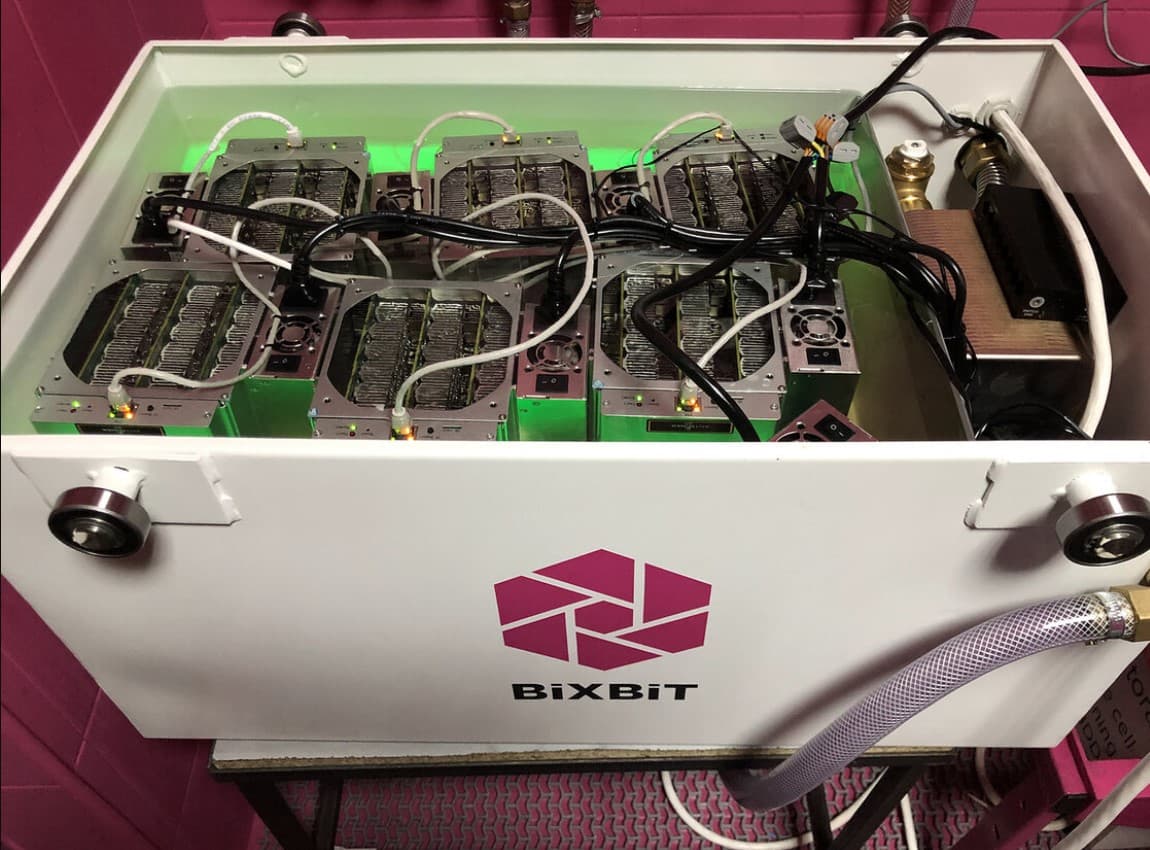
Immersion mining means running ASIC miners submerged in a dielectric fluid, a liquid that does not conduct electricity, instead of blowing air through them. The fluid touches every component, absorbs the heat, and is pumped through a heat exchanger that passes the heat to an outdoor cooler. Mining uses single-phase immersion, where the fluid stays liquid throughout. It gives quiet, dust-free, dense operation and makes heat easy to reuse, at the price of tanks, a large volume of fluid, and messier servicing.
Key points
- Single-phase immersion is a tank, a dielectric fluid, a pump, a heat exchanger and an outdoor cooler. Size all of them for the full electrical load.
- Manufacturers now publish immersion-specification models with their own fluid temperature and flow requirements. These are the low-risk route.
- Converting an air-cooled machine involves removing its fans and changing how it is controlled. Check the manufacturer's warranty terms before you do it.
- Dielectric fluids carry less heat per litre than water, so immersion needs more flow than a hydro loop for the same load.
- Higher-power modes raise hashrate but worsen efficiency; overclocking beyond manufacturer modes also carries warranty and lifespan consequences.
How single-phase immersion works
- Tank. An open-top or lidded steel tank holds the machines vertically in a row, with power and network connections above the fluid line.
- Dielectric fluid. Usually a hydrocarbon or synthetic oil engineered for electronics. It is electrically insulating, so powered boards can sit in it.
- Circulation. A pump draws warm fluid from the top of the tank or an overflow weir and returns cooled fluid at the bottom, so it rises through the machines past the chips. Baffles force the fluid through the machines and not around them.
- Heat exchanger. A plate heat exchanger transfers heat from the fluid to a water or water-glycol loop without the two liquids mixing. Some designs send the fluid directly to an oil-to-air cooler and skip the water loop.
- Dry cooler or cooling tower. The outdoor unit rejects the heat to air. A dry cooler uses no water; a tower evaporates water to reach lower temperatures.
In two-phase immersion the fluid boils on the chips and condenses on a coil above the bath. It removes heat very effectively but needs sealed tanks and costly engineered fluids, and it is not the form commonly deployed in mining.
Purpose-built immersion miners
Manufacturers publish immersion models designed to run submerged, without fans, and specified against fluid temperature and flow instead of air temperature. Two examples, using manufacturer-published figures:
| Antminer S21 XP Imm. (Bitmain) | WhatsMiner M66S 290T (MicroBT) | |
|---|---|---|
| Hashrate | 300 TH/s normal mode, 380 TH/s high mode | 290 TH/s |
| Power at the wall | 4,050 W normal, 5,700 W high | 5,365 W |
| Efficiency | 13.5 J/TH normal, 15.0 J/TH high | 18.5 J/TH |
| Rating condition | 30 °C inlet fluid | not stated |
| Inlet fluid temperature | 20–50 °C | 25–55 °C in normal mode |
| Fluid flow per machine | 1 m³/h (16.7 L/min) | at least 24 L/min |
| AC input | 380–415 V three-phase | 380–480 V |
Bitmain's figures are typical values with a stated tolerance of ±3% on hashrate and ±5% on power. It names the two modes NEM (Normal Energy Mode) and HEM (High Energy Mode); they are operating modes of the same hardware. MicroBT's datasheet names the coolant as an insulating liquid and lists the fluid grades it accepts, so the fluid choice is part of the specification, not a free decision.
The two Bitmain modes show a trade-off that applies to every miner. Going from normal to high mode adds 80 TH/s for 1,650 W more power. That extra hashrate costs 1,650 ÷ 80 = 20.6 J/TH, against 13.5 J/TH for the base load. Whether the high mode pays depends on your electricity price and current network conditions; test both in the calculator.
Why immersion needs more flow than hydro
Heat carried is Q = ṁ × c × ΔT. Water has a specific heat of about 4.18 kJ/kg·K at about 1 kg/L. Dielectric oils are lighter and hold less heat. Taking an illustrative fluid of 0.8 kg/L and 2.1 kJ/kg·K (use your fluid's data sheet for real values), a litre carries 0.8 × 2.1 = 1.68 kJ per kelvin, about 40% of water's 4.18. For the same heat and temperature rise you need about 2.5 times the volume flow.
Applied to Bitmain's published 1 m³/h for the S21 XP Imm.:
| Normal mode | High mode | |
|---|---|---|
| Heat load | 4.05 kW | 5.70 kW |
| Mass flow at 1 m³/h, 0.8 kg/L | 0.222 kg/s | 0.222 kg/s |
| Temperature rise, Q ÷ (ṁ × c) | 4.05 ÷ (0.222 × 2.1) = 8.7 K | 5.70 ÷ (0.222 × 2.1) = 12.2 K |
A tank of 20 such machines needs 20 m³/h of fluid circulation and, in high mode, rejects 114 kW (about 389,000 BTU/h).
Converting air-cooled machines
Before immersion models existed, operators submerged standard air-cooled units, and many still do. Conversion typically involves:
- Removing the fans. They are not needed in fluid and impede its flow.
- Changing the control side. Stock firmware monitors fan speed and stops hashing when fans are missing, which is a protective feature. Converted units therefore run firmware or hardware that no longer depends on fan signals. This guide does not describe how to do that.
- Checking material compatibility. Some cable jackets, plastics, seals, labels and thermal interface materials soften, harden or leach in oil. Fluid suppliers publish compatibility guidance.
The warranty position is the deciding factor. MicroBT's published warranty policy excludes damage from disassembly or modification without its authorisation, from unofficial software, from unofficial accessories, and from failure to use the specified liquids. Bitmain's policy is set out in its Product Warranty article and service terms. Read the terms that apply to your machines before converting; assume that a converted air-cooled unit will not be accepted for warranty repair unless the manufacturer says otherwise in writing.
Benefits
- No fans in the machine. No fan failures, no fan power draw, and very little noise at the tank. Pumps and the outdoor cooler make the noise.
- Isolation from the environment. Dust, sand, salt air and humidity do not reach the boards.
- Even temperatures. Fluid surrounds every component, so there are fewer hot spots than in an air stream that warms as it crosses the board.
- Density. Machines sit close together because no air path is needed.
- Heat reuse. The heat arrives as warm liquid that a heat exchanger can pass to a building or process loop.
Costs and drawbacks
- Capital. Tanks, fluid, pumps, heat exchangers, an outdoor cooler, pipework and spill containment. Fluid volume is large and is a recurring cost when topped up or replaced.
- Weight. Fluid-filled tanks are heavy; check floor loading.
- Servicing. Pulling a machine means lifting it, letting it drain over the tank, and handling an oily unit. Repairs take longer; check in advance whether your repair route accepts machines that have been in fluid.
- Resale. A machine that has been in oil is harder to sell and awkward to return to air cooling.
- Single points of failure. A pump or cooler fault affects the whole tank, so design in redundancy and high-temperature shutdown.
- Fire and environmental rules. Many dielectric fluids are combustible. Read the safety data sheet and follow local fire and spill regulations.
Fluid handling and maintenance
- Keep water out. Moisture lowers the fluid's insulating strength. Keep lids closed, and never service a tank with wet hands or tools.
- Keep it clean. Filter the circulating fluid and remove debris; particles and fibres collect on boards.
- Keep the level up. Components must stay submerged. Fluid leaves with every machine you lift out, so plan for top-up.
- Monitor supply temperature and flow against the manufacturer's limits, and alarm on pump failure.
- Sample the fluid on the schedule the fluid supplier recommends, and do not mix different fluids.
- Use drip trays, absorbent material and gloves. Oil on a floor is a slip hazard.
Power connections, PDUs and three-phase distribution around tanks must be designed and installed by a qualified electrician to local code.
Overclocking
Operators often use immersion's thermal headroom to run machines above their rated power. There are two different things under that label. Manufacturer modes, such as Bitmain's HEM, are published and supported operating points. Overclocking beyond them, usually with third-party firmware, pushes chips and power supplies past what the manufacturer rated.
The facts to weigh: efficiency falls as power rises, as the marginal 20.6 J/TH above shows; power supplies and connectors carry more current and run hotter; and MicroBT's warranty policy explicitly excludes products damaged, or whose service life is shortened, by self-modification of operating parameters such as overclocking. Check your manufacturer's terms and treat any gain as coming with a cost in warranty cover and component life.
Sources
- Bitmain Support, "S21 Imm. Specifications" (definition of NEM and HEM modes, fluid flow of 1 m³/h), https://support.bitmain.com/hc/en-us/articles/35746238371097-S21-Imm-Specifications, checked 2026-10-01.
- MicroBT, "WhatsMiner Hydro-Cooling Miner Operation Guide V2.3", section 11.2 After-Sales Warranty Policy (PDF), https://aws-microbt-com-bucket.s3.us-west-2.amazonaws.com/WhatsMiner%C2%A0Hydro-Cooling%C2%A0Miner_Operation%C2%A0Guide%C2%A0V2.3_1785321522546.pdf, checked 2026-10-01.
- Bitmain Support, "Product Warranty", https://support.bitmain.com/hc/en-us/articles/223400048-Product-Warranty, checked 2026-10-01.
- Bitmain Support, "Troubleshooting for Fans Problems", https://support.bitmain.com/hc/en-us/articles/360016404114-Troubleshooting-for-Fans-Problems, checked 2026-10-01.